


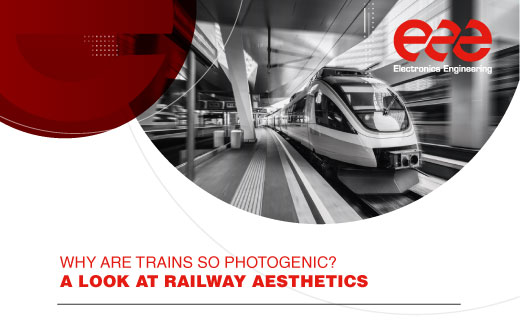
There is something fascinating about trains: even people who have never considered themselves railway enthusiasts often stop to take a photograph of one. Whether a train is crossing a bridge, pulling into a historic station, or passing through a stunning landscape, someone is almost certain to reach for their phone.
The same cannot be said for most other forms of transport. Few people stop to admire a city bus or wait for the perfect moment to photograph a truck. Yet trains possess a unique ability to capture our attention.
Why is that?
The answer lies in a combination of industrial design, engineering, architecture, and even visual psychology. Because, although we may not always realise it, trains are designed not only to be efficient but also to evoke emotion.
The Beauty of Long, Flowing Lines
The human brain naturally finds harmony in continuous, well-proportioned shapes—and few objects embody these qualities better than a train.
Its length creates a sense of continuity that becomes especially striking as it moves through the landscape or disappears into the perspective of a railway station. At the same time, railway tracks naturally act as leading lines, drawing the eye toward the horizon and creating compositions that are almost perfect for photography.
It is no coincidence that many of the most iconic railway images rely on this sense of endless perspective.
Design Shaped by Engineering
Perhaps the most interesting aspect is that much of railway aesthetics is not driven solely by artistic intention. Every curve, every streamlined nose, and every surface is shaped—at least in part—by engineering requirements.
In high-speed trains, for example, aerodynamic profiles improve airflow, reduce drag, and minimise noise during operation. The result is a design that feels clean, elegant, and perfectly balanced, where functionality naturally becomes beauty.
It is one of those rare examples where engineering and design speak exactly the same language.
The Appeal of Movement
A stationary train is already an impressive sight. Once it begins to move, the experience changes completely.
Its motion creates a sense of dynamism that is difficult to find in other vehicles. A train moves continuously, precisely, and predictably, following a perfectly defined path along the tracks.
To the human eye, this creates a fascinating combination of speed and stability.
That is why long-exposure photographs, panning shots, and images captured as trains pass by often have such a powerful visual impact.
Every Train Has Its Own Personality
Interestingly, many people can recognise certain train models simply by their silhouette.
Just as with cars or aircraft, every manufacturer develops its own design language. Over time, this visual identity becomes part of the travel experience itself.
The Emotional Connection
Beyond design, there is another factor that is much harder to measure: emotion.
Trains are deeply embedded in our collective memory. They represent journeys, farewells, reunions, holidays, work, and discovery.
That emotional connection transforms every railway photograph into something more than just a technical image.
When Engineering Inspires
At Triple E, we develop technological solutions for the railway industry every day. Yet behind every electronic system, every onboard device, and every innovation is a train that, beyond fulfilling a vital operational role, has become part of our landscapes, our cities, and the lives of millions of people.
Perhaps that is why trains are so photogenic.
They combine precision, movement, history, design, and innovation in a single object.
And they remind us that, sometimes, the finest engineering is measured not only by its performance, but also by its ability to inspire admiration before it even begins to move.