


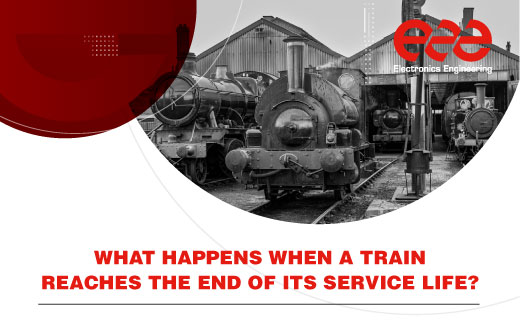
When a train enters service, it begins a lifespan that, in many cases, exceeds 30 or even 40 years. During that time, it will travel millions of kilometres, carry thousands of passengers, and undergo countless maintenance operations, inspections, and technological upgrades.
Eventually, however, a point is reached where keeping the train in operation is no longer the best option. This is not always because it has stopped working, but because technology evolves, new regulatory requirements emerge, operators’ needs change, or the cost of maintaining certain systems becomes too high.
Does that mean the train simply ends up as scrap?
The answer is far more interesting.
A Train Doesn’t “Expire” Overnight
Unlike many other forms of transport, retiring a train is usually a carefully planned process that begins years in advance.
Rail operators assess a wide range of factors before making that decision, including:
- Structural condition of the vehicle
- Maintenance costs
- Availability of spare parts
- Energy consumption
- Compliance with current regulations
- Operational reliability
In many cases, a train could technically continue operating. However, maintaining it may no longer be cost-effective compared with introducing newer rolling stock offering greater efficiency or improved performance.
For this reason, the end of a train’s service life is rarely the result of a single factor. It is the outcome of a comprehensive technical, economic, and operational assessment.
Before Retirement, Many Trains Are Modernised
Not every train goes directly to the scrapyard.
In fact, one of the most common practices is mid-life refurbishment, a process in which numerous systems are upgraded to extend the vehicle’s operational life for many more years.
These upgrades may include:
- Interior refurbishment
- Replacement of electronic systems
- HVAC system upgrades
- Installation of new passenger information systems
- Safety system upgrades
- Integration of more energy-efficient technologies
In many cases, these improvements allow a train to remain in service for another decade—or even longer—without replacing the entire fleet.
Electronics Have Their Own Lifecycle
One of the greatest challenges lies in electronic systems.
While a railway vehicle may remain in operation for several decades, many of its electronic components have much shorter manufacturing lifecycles.
Processors, memory devices, communication modules, and other electronic components often become obsolete long before the train itself reaches the end of its service life.
This requires manufacturers and operators to manage technological obsolescence by identifying equivalent components or redesigning specific equipment while maintaining exactly the same levels of safety and performance.
Although largely invisible to passengers, this work is essential to ensuring uninterrupted service.
At Triple E, we are very familiar with this challenge. Developing electronic systems for safety-critical applications means considering the entire product lifecycle from the very beginning—anticipating future upgrades, facilitating maintenance, and minimising the impact of technological obsolescence over time.
When the Time Finally Comes
If a train is ultimately withdrawn from service, a new stage begins.
The process involves far more than simply dismantling the vehicle.
Before dismantling, several important steps are carried out:
- Removal of reusable equipment
- Safe disposal of fluids and hazardous materials
- Separation of components
- Sorting of recyclable materials
- Waste management in accordance with environmental regulations
A large proportion of the steel, aluminium, copper, and glass can be recovered and reused in new industrial processes.
In some cases, electronic or mechanical equipment can also be reused as spare parts for other trains of the same series.
A Second Life… Somewhere Else
Not every retired train disappears from the railway network forever.
Some units are sold to other operators or countries where they can continue operating for many more years.
This is a common practice when the rolling stock remains reliable and meets the operational requirements of its new owner.
Reusing trains in this way maximises previous investments while reducing the environmental impact associated with manufacturing new vehicles.
Circular Economy on Rails
Sustainability in the railway industry does not begin when a train consumes less energy.
It also depends on how the train is designed, maintained, and managed once it reaches the end of its operational life.
Today, manufacturers and operators increasingly embrace circular economy principles by designing vehicles that are easier to repair, equipped with recyclable components, built with upgradeable systems, and engineered for easier dismantling at the end of their service life.
The easier it is to maintain, modernise, or reuse a train, the greater its contribution to a truly sustainable transport model.
Designing Today with the Next Thirty Years in Mind
Railway engineering often focuses on performance, safety, and reliability. But there is another equally important question:
How will the system evolve over time?
Designing only for commissioning is no longer enough.
Engineers must also anticipate future upgrades, component replacement, obsolescence management, and decades of maintenance.
This long-term vision is an integral part of the work we do at Triple E. Every electronic solution we develop for safety-critical systems is designed not only to perform reliably from day one, but also to remain maintainable, upgradeable, and dependable throughout its entire operational life.
Because in the railway industry, the end of a train’s service life does not mark the end of engineering.
In many cases, it is simply the beginning of a new chapter.