


Just over a century ago, traveling by train was a very different experience from what we know today. Steam set the pace, open windows were part of the journey, and trips were measured more in time than in efficiency. Technology was present, but in a much more visible, mechanical, and, in a way, simpler form.
Today, however, much of what makes train travel possible is no longer visible.
From mechanical to electronic
For decades, the evolution of railways was mainly driven by mechanical improvements: more powerful locomotives, stronger materials, and more efficient traction systems. But over time, the focus began to shift.
Electronics started to take center stage—first as support, then as a key element.
Control systems, automation, onboard signaling, and energy management became part of the train’s internal operation. As a result, technical complexity increased significantly.
What once depended on physical mechanisms is now managed by electronic systems capable of making real-time decisions. In this new context, designing reliable onboard electronics becomes essential to ensure everything works as it should.
A train that “thinks” in real time
Today, a modern train doesn’t just move—it monitors, analyzes, and responds.
Sensors distributed throughout the vehicle continuously collect data: temperature, pressure, system status, energy consumption… everything is monitored in real time. This information makes it possible to anticipate failures, optimize maintenance, and improve operations.
For passengers, this translates into greater comfort and reliability. For engineers, it represents a fundamental shift in how systems are designed and operated.
Because it’s no longer just about making something work—it’s about ensuring it can adapt and respond to different situations. This is where experience in developing critical systems becomes especially important, particularly when system response cannot fail.
Connectivity as the new standard
Another major shift has been connectivity.
Modern trains are no longer isolated systems. They are integrated into networks, exchanging information with control centers, maintenance systems, and other infrastructure. This interconnection enables more efficient management, but also introduces new challenges.
The greater the communication capability, the greater the system complexity.
And with it comes the need to ensure everything operates securely—both operationally and technologically. Designing systems that can integrate into these environments without compromising reliability is now one of the key challenges in railway engineering.
When cybersecurity comes into play
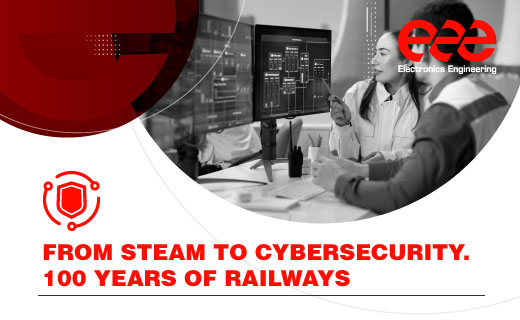
A century ago, railway safety focused on physical and operational aspects. Today, without abandoning those elements, a new dimension has emerged: cybersecurity.
Connected electronic systems expand the surface exposed to potential threats. It is no longer just about preventing internal failures, but also about protecting systems from unauthorized access or external interference.
This makes it essential to integrate cybersecurity from the design stage, as an inherent part of the system—not as an added layer at the end.
In environments where functional safety and digital security coexist, the development of robust and well-integrated solutions makes all the difference.
A continuous evolution
Over the past 100 years, railways have evolved from predominantly mechanical systems into complex technological platforms where electronics, software, connectivity, and now cybersecurity all coexist.
However, one thing has not changed: the need for everything to work reliably.
Behind every advancement, every improvement, and every new technology lies the same objective: ensuring the system responds when needed. And this is precisely where specialized engineering remains essential to sustain the sector’s evolution.
Looking ahead
If railways have proven anything, it is their ability to adapt. They have evolved with each technological shift without losing their essence.
Today, that evolution involves integrating new tools, managing large volumes of data, and protecting increasingly interconnected systems.
And, as always, the challenge is not just about adopting technology—but about doing so with sound judgment.
At Triple E, this evolution is experienced from within: contributing to the development of electronic systems for critical environments and adapting solutions to the sector’s new demands. Because although the context has changed, the foundation remains the same: designing reliable, safe systems ready to respond when it matters most.
Because behind every journey—whether visible or not—the same thing remains as it did 100 years ago: engineering.