


n many critical sectors, safety has traditionally relied on vigilance, manual intervention, and human reaction. But there are environments where that simply isn’t enough.
Unattended facilities, 24/7 operations, distributed systems, or high-risk scenarios make relying solely on humans for safety a risky bet. Not because people fail—though they sometimes do—but because there are situations where they cannot be present, arrive in time, or have all the necessary information.
For this reason, in sectors like rail, maritime, or energy, safety is evolving toward a different model: systems capable of anticipating, detecting, and responding autonomously, backed by technical guarantees and certifications to ensure reliability.
The Limits of the Human Factor in Critical Environments
Human error is one of the main causes of incidents in complex systems. Fatigue, information overload, adverse environmental conditions, or simple delays in decision-making can be the difference between a controlled incident and a critical situation.
Another key factor is the absence of personnel in certain scenarios. Remote infrastructures, tunnels, isolated rail sections, technical rooms, or facilities operating without constant supervision require a different approach.
In these cases, safety cannot rely on someone “noticing.” It must be built into the system itself.
Functional Safety: When the System Makes Reliable Decisions
This is where functional safety comes into play—an approach based on designing electronic systems capable of detecting hazardous conditions and automatically taking the system to a safe state.
In rail, this approach is embodied in standards like SIL2 (Safety Integrity Level 2), which define strict requirements for design, architecture, validation, and maintenance to ensure a system performs its safety function with an acceptable level of risk.
A SIL2 system doesn’t just work:
-
It works when it has to
-
It fails safely when something goes wrong
-
It is designed, verified, and documented to prove it
Sensors and Critical Electronics: Seeing Before Something Happens
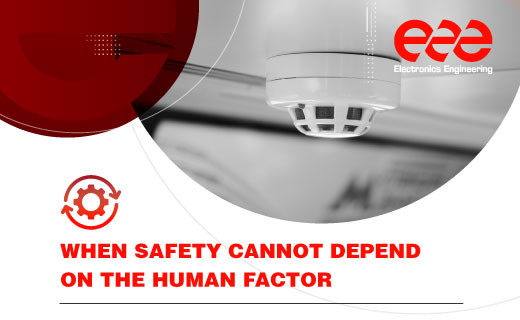
The foundation of any autonomous safety system is advanced sensing. Detecting temperature, smoke, gases, vibrations, electrical states, or abnormal conditions allows risks to be anticipated before they turn into incidents.
But sensors alone are not enough. The key lies in the critical electronics that processes this information:
-
Analyzes data in real time
-
Applies certified decision-making logic
-
Triggers automatic responses (alarms, shutdowns, protection systems)
All of this occurs without immediate human intervention and with reaction times impossible to achieve manually.
Functional safety beyond Rail: A Cross-Sector Approach
Although the rail sector has pioneered SIL systems and safety electronics, this approach is increasingly relevant in other industries:
-
Maritime, with confined spaces and unattended operations
-
Energy, where delayed detection can have serious consequences
-
Critical infrastructure, which requires operational continuity and maximum reliability
The logic is the same in all cases: design systems that do not depend on the constant presence of people to guarantee safety.
Designing Safety from the Start
Safety should not be an add-on or an afterthought. In critical environments, it must be integrated from the very beginning, embedded in the system architecture, electronics, and operational logic.
At Triple E, we work under this principle: developing electronic solutions and functional safety systems that protect people and assets even when no one is watching, meeting the strictest standards and adapting to each operational environment.
Because when the risk is real, safety cannot depend on arriving on time. It must always be there.