


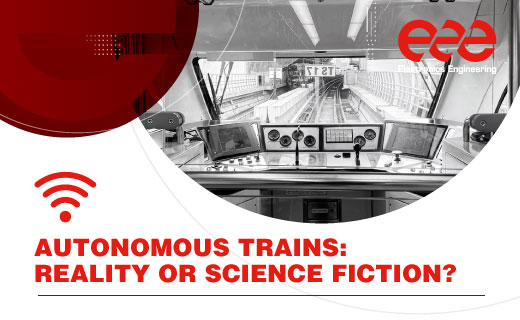
For a long time, talking about autonomous trains meant talking about the future—and quite a distant one at that. The typical image was a fully driverless train, making decisions on its own, almost like something out of a movie.
But the reality is that many of these technologies already exist. Some of them have been operating for years.
What happens is that railway automation has not arrived all at once, nor in the dramatic way it is sometimes imagined. It has gradually made its way into the sector, integrating into specific systems until becoming a standard feature in many railway operations.
So rather than asking whether autonomous trains are real or not, perhaps the more interesting question is: how far can this automation actually go?
Autonomous trains: automation does not mean removing the driver
When we talk about autonomy, we often immediately think of driverless trains. But between a fully manual system and a fully autonomous one, there are many intermediate levels.
For years, many trains have already automated tasks such as speed control, acceleration, braking, or door operation. In some metro systems—especially in closed and highly controlled environments—driverless operations already exist.
Cities such as Singapore, Dubai, and several lines in Paris have been working with these types of solutions for some time.
In other words, railway automation is already part of the present. It is just that, in most cases, it operates in the background and passengers barely notice it.
Moving the train is not the hard part
From a technical point of view, making a train accelerate, brake, or follow a route is not the biggest challenge. The difficulty comes when the system has to interpret situations, react to unexpected events, or make safe decisions.
This is where all the less visible elements come into play:
- sensors
- onboard electronic systems
- real-time communications
- data analysis
- system redundancy
- cybersecurity
Everything must be coordinated and ready to respond even when something fails.
Because in the railway sector, it is not enough for a technology to work “almost always”. It must operate reliably in every foreseeable situation.
Safety continues to set the pace
And this is probably one of the biggest differences compared to other technology sectors.
In the railway industry, any advancement must coexist with very high safety requirements. Every automated system must go through validation, testing, and certification before being introduced into real operation.
That is why progress tends to be more gradual than many expect.
It is not just about developing new technology, but about proving that it can operate safely and consistently for years, in real conditions and complex environments.
In this context, standards such as SIL2 are essential to ensure that both hardware and software behave as required when part of critical systems.
In this evolution, we are already seeing projects that reflect where the sector is heading. One example is CAF, which is manufacturing new autonomous trains for Madrid Metro—rolling stock where automation advances hand in hand with safety, not separately.
In developments like these, passenger protection remains a core part of system design. In the case of Triple E, this approach translates into the integration of a 360 fire detection and suppression solution, specifically designed for railway environments and aimed at ensuring passenger safety at all times—even in critical scenarios.
Data is also transforming operations
Another major shift in recent years is the amount of information generated by modern trains.
Today, many systems are capable of continuously monitoring temperatures, energy consumption, component status, and operational behaviour. All of this makes it possible to detect anomalies before they become major issues.
And this is where technologies such as artificial intelligence and predictive analytics start to make real sense within the sector.
Not as futuristic concepts, but as practical tools to support better decision-making and anticipate incidents.
So… will we see fully autonomous trains?
Most likely, yes. But not immediately, and not in all environments at the same time.
In closed and highly controlled lines, full autonomy already exists. In more complex networks, with mixed traffic and multiple external variables, the process will take longer.
And that is probably a good thing.
Railways have never been a sector that takes unnecessary risks. Every technological advancement goes through multiple layers of validation before reaching daily operation, and that is precisely what makes it one of the safest transport modes in the world.
At Triple E, we are closely involved in this evolution, participating in the development of electronic systems for critical environments where automation and safety must advance together.
Because in the end, behind every autonomous system, there is still the same foundation it has always had: engineering, validation, and many hours ensuring everything behaves exactly as it should.